

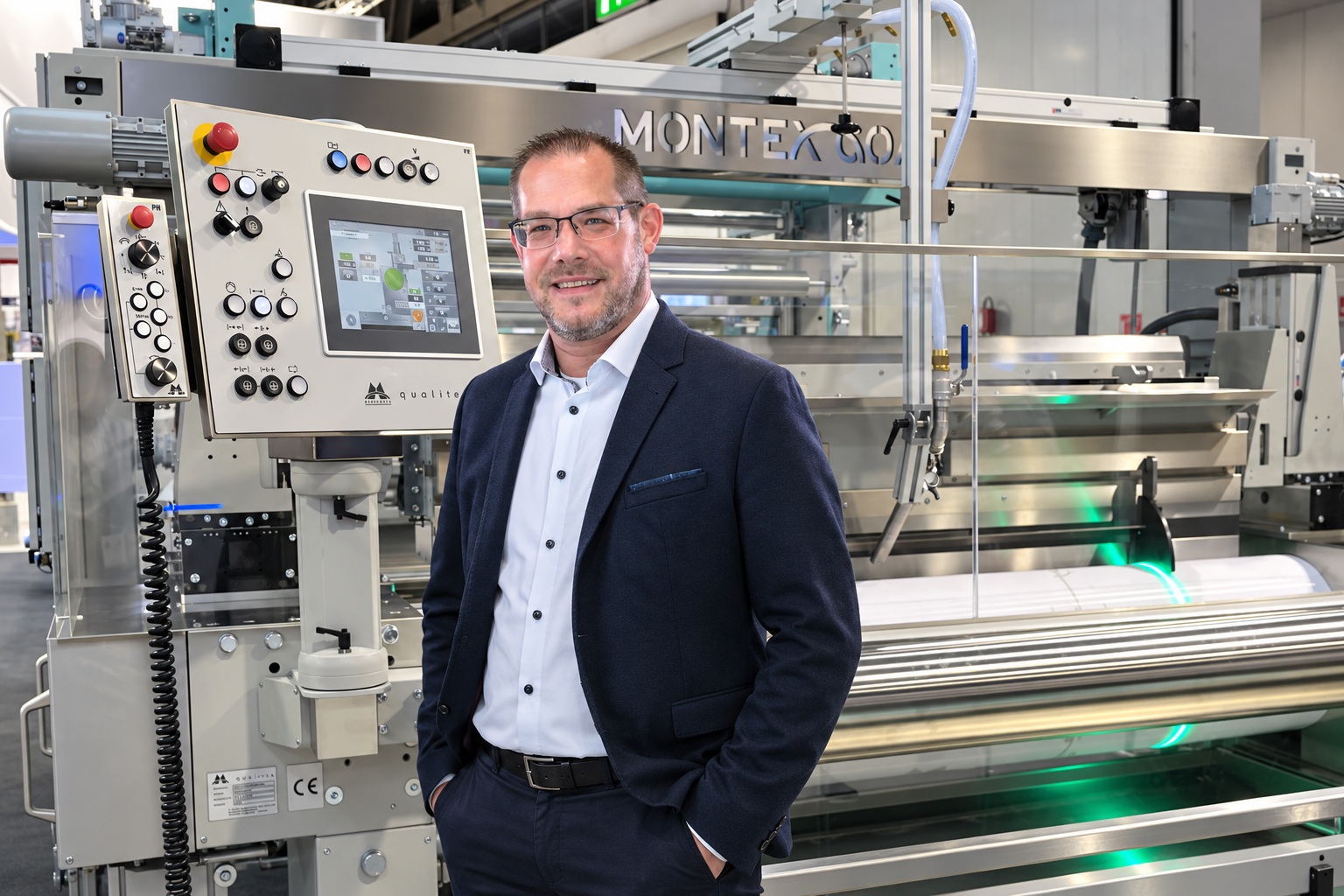
Advanced finishing, coating and energy-efficient processing will be highlighted by Monforts at India ITME 2026, as the region’s textile manufacturers increasingly look beyond volume production towards higher-value fabrics.
The German finishing machinery specialist sees considerable potential in India as investment continues in conventional apparel and home textiles alongside rapidly developing markets for technical textiles, activewear, sportswear, filtration and automotive applications.
Supporting this next phase of growth will be newly appointed Monforts Area Sales Manager for Asia Daniel Rütten, who is taking over responsibility for India and the wider region from Hans Wroblowski.
Daniel Rütten brings extensive Monforts experience to the position, having joined the company in 1998 and worked for many years in head office sales and logistics before more recently taking on responsibility for customers in Latin America.
Scale and breadth
“India remains one of the most important markets for Monforts, not only because of the scale of its textile industry but because of the breadth of its manufacturing base,” he says. “Indian manufacturers are looking much more closely at energy, water and chemical consumption, as well as the level of automation required to achieve consistent quality. “Productivity remains essential, but increasingly it has to be combined with lower operating costs, greater flexibility and the ability to manufacture more sophisticated products.”
At India ITME 2026 at stand A5 in Hall 1 from December 4-9, Monforts will emphasise the opportunities for manufacturers to create greater value at the finishing stage.
MONTEX stenters and THERMEX dyeing and curing systems continue to be developed to achieve high and consistent production while reducing energy consumption. This is particularly important in drying, one of the most energy-intensive stages of textile finishing.
The Monforts Eco Applicator addresses this by applying finishing chemicals with a minimum amount of liquor rather than unnecessarily saturating the fabric. With less water subsequently needing to be evaporated, significant savings in water, chemicals and energy can be achieved.
For the growing Indian technical textiles sector, Monforts is also expanding its coating options. The multifunctional MontexCoat provides knife coating, magnet roller coating, rotary screen printing and other application techniques, while the more cost-effective coaTTex line is aimed primarily at manufacturers concentrating on knife coating. It is now also available with a table for special coating technology for activewear.
Sustainable chemistries
Monforts has additionally entered into a cooperation with BW Converting, with a Baldwin TexCoat G4 digital spray unit installed at its Advanced Technology Center (ATC) in Mönchengladbach for trials with the latest advanced sustainable finishing chemistries supplied by Archroma.
“Basic fabric production is increasingly competitive and commoditised, but finishing is where much of a fabric’s appearance, handle, functionality and ultimately its value are created,” Daniel Rütten says. “The opportunity for Indian manufacturers is not simply to produce more fabric, but to extract greater value from every metre produced.”
Central to Monforts’ activities in India is its long-established partnership with A.T.E. Enterprises, which has local business units in all of the country’s major textile regions. A.T.E.’s role extends from initial customer contact to project planning, logistics, engineering and aftersales services – an important consideration given the long working life of Monforts equipment.
Many Monforts stenters have been operating for more than three decades, and modernisation of this installed base is becoming an increasingly important part of the company’s business. Existing lines can be upgraded with new controls, drives, monitoring and other technologies to improve productivity, energy efficiency and process control while extending their useful operating life.
“The combination of Monforts engineering and A.T.E.’s presence on the ground has proved very effective,” Daniel Rütten says. “Customers require a relationship that continues long after installation, covering service, spare parts, upgrades and increasingly sophisticated modernisation projects.”
Looking further ahead, Monforts believes the developing relationship between India and Europe could encourage further investment and technical cooperation, including in alternative energy technologies.
The company has already carried out work on adapting heating technology to green hydrogen as a substitute for natural gas in energy-intensive processes such as drying and heat treatment. India’s rapidly developing renewable energy and green hydrogen sectors could make this an important area for future cooperation.
“Over the next decade, volume alone will not define competitiveness,” Daniel Rütten concludes. “Indian manufacturers have an opportunity to move further into specialised, higher-value fabrics, but doing so will require increasingly precise and flexible finishing technology.
“That is where we see some of the strongest opportunities for Monforts in India.